For Research Use Only. SS-31 is intended exclusively for in vitro and preclinical research. It is not approved for human use, is not a drug, and should never be administered to humans or to animals outside of an authorized research protocol. Sourcing guidance in this article concerns research procurement only.
Why Sourcing Matters for SS-31 Research
The SS-31 research literature is built on the assumption that the reference compound being studied matches the labeled identity and meets a defined purity threshold. When that assumption is incorrect, mechanism work is uninterpretable, comparison work between studies becomes meaningless, and the cumulative literature accumulates noise rather than signal. The single most consequential decision a research program makes about SS-31 is which supplier to source from, because that decision determines whether the cumulative work contributes to the literature or undermines it.
Sourcing decisions therefore deserve the same rigor that researchers apply to experimental design. The criteria below describe the documentation and quality practices that distinguish research-grade material from commercial peptide products that lack complete characterization. Research programs that apply these criteria consistently produce more reliable data than programs that treat sourcing as an afterthought.
The SS-31 sequence (D-Arg-2',6'-dimethyltyrosine-Lys-Phe-NH₂) is also a particular synthesis challenge because it includes a non-standard D-amino acid at the first position, a modified tyrosine residue (2',6'-dimethyltyrosine, abbreviated Dmt), and a C-terminal amide. Each of these features requires correct synthesis chemistry to produce the active research compound. Material that does not correctly incorporate these features is not biologically equivalent to the published SS-31 reference compound.
Certificate of Analysis Requirements
A complete certificate of analysis is the single most important document a research-grade SS-31 supplier provides. The COA should be issued by an independent third-party laboratory rather than self-issued by the supplier, since self-issued documentation creates an obvious conflict of interest that the published literature has repeatedly flagged as a source of unreliable material. The third-party COA should document several specific measurements.
Identity by mass spectrometry. The measured molecular mass should match the theoretical mass for the SS-31 sequence including the D-arginine, dimethyltyrosine, and C-terminal amide modifications, to within standard mass spectrometry precision. Identity confirmation by MS rules out the most common forms of supplier substitution.
Purity by HPLC. The HPLC chromatogram should report area percent purity, typically expected above 98 percent for research-grade material. The chromatogram itself (not just the reported number) is the most informative element, since it documents what the impurity profile looks like. For SS-31, common synthesis-related impurities include incorrect stereochemistry at the D-arginine position, incomplete dimethylation of the tyrosine, and C-terminal acid (without amide). Each of these impurities can change the biological activity, and the HPLC chromatogram should resolve them.
Endotoxin and microbial screening. The COA should document endotoxin levels and bacterial contamination screening. Material that fails these screens should not be used in cell culture or in vivo research because the contaminants can produce signals that look like compound effects, particularly in mitochondrial research where mitochondrial dysfunction itself can be triggered by endotoxin exposure.
Lot identification and date. The COA should identify a specific manufacturing lot and the date of analysis, which are necessary for reproducibility across studies that use material from the same lot.
The Nature subject hub on analytical chemistry and the ScienceDirect topic page on peptide synthesis archive primary research on the analytical methods that underlie peptide identity and purity characterization.
Manufacturing and Synthesis Provenance
Research-grade SS-31 is produced by solid-phase peptide synthesis (SPPS), which is the standard method for synthetic peptides of this length. The supplier should be transparent about the synthesis location and the manufacturing facility, since the geographic and regulatory context of the synthesis affects the reliability of the documentation. Material synthesized in facilities that follow standard analytical practices and provide complete documentation is more reliable than material from facilities that operate without such practices.
The published literature flags certain failure modes that occur when synthesis provenance is opaque. These include sequence errors (one or more residues different from the labeled sequence), incomplete deprotection (residual protecting groups on amino acid side chains), aggregation impurities (peptide multimers that co-elute with the target), incorrect stereochemistry at the D-arginine position, and incomplete dimethylation of the tyrosine residue. Each of these failure modes can be detected by complete COA documentation but is invisible without it.
Storage, Lyophilization, and Stability
SS-31 is supplied as a lyophilized powder, which is the form that has the longest shelf life under standard storage conditions. Lyophilized peptide stored at low temperature in a sealed vial maintains identity and purity over extended periods, while reconstituted peptide is more sensitive to temperature, light, and time. The supplier should document the lyophilization method, the shipping temperature, and the recommended storage conditions. Material that arrives compromised because of inadequate shipping or that lacks shipping temperature documentation introduces uncertainty into downstream work.
This article does not address reconstitution, dilution, or administration of SS-31 because those activities fall outside the scope of research procurement and are not appropriate for general guidance. Research programs follow their own institutional protocols for handling research compounds, and the compound itself is for in vitro and preclinical research only.
Distinguishing Research-Grade From Commercial Material
The peptide market includes a wide range of suppliers with varying levels of documentation and quality. The published research literature has documented cases where commercial peptide products labeled with specific sequences contained different sequences when independently analyzed, contained substantially lower purity than labeled, or contained contaminants that produced confounding effects in research designs. These failures occur because some commercial suppliers operate without third-party analytical documentation and rely on customer trust rather than verified characterization.
Research-grade SS-31 is distinguished by several practical signals. The supplier provides a third-party COA on request rather than only on demand. The supplier identifies the manufacturing facility and synthesis method. The supplier documents lot identification and provides batch traceability. The supplier responds substantively to technical questions about identity, purity, and stability rather than referring all questions to generic customer service. Research programs that source consistently from suppliers meeting these criteria produce more reproducible work than programs that source by price alone.
The Wiley Online Library research peptide collection archives primary research on synthetic peptide quality and characterization relevant to sourcing decisions.
Midwest Peptide SS-31 Sourcing
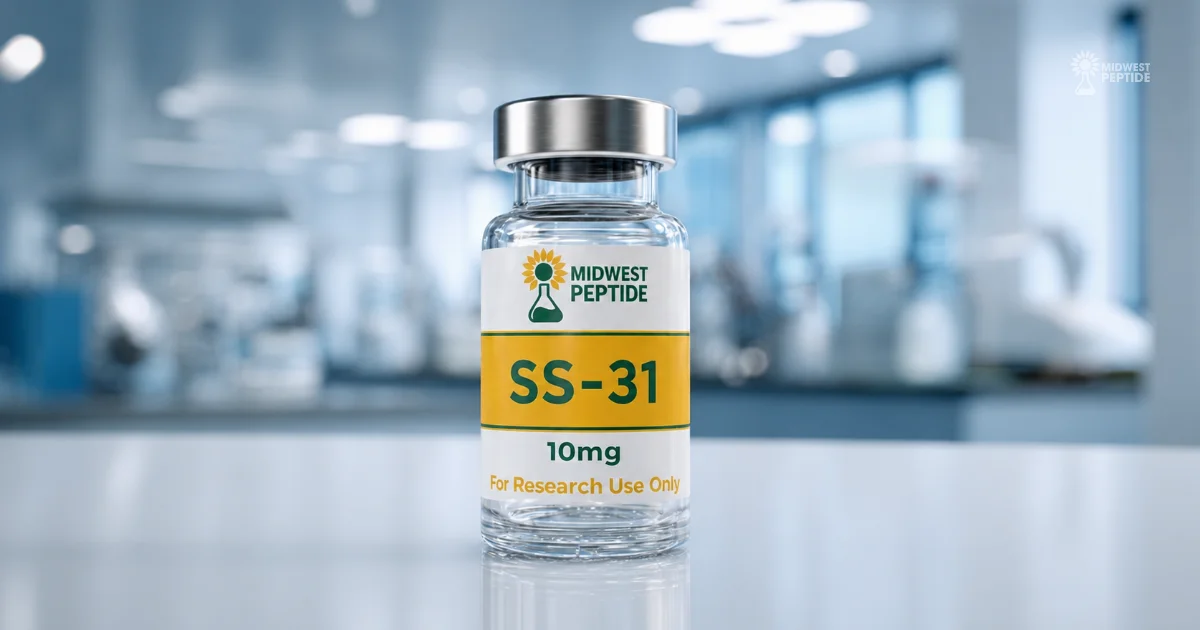
Midwest Peptide supplies SS-31 10mg as a research-grade reference compound with third-party COA documentation, defined sequence including the D-arginine and dimethyltyrosine modifications, HPLC purity reporting, and endotoxin screening. The product is provided in lyophilized form and ships under controlled conditions. The compound is positioned for in vitro and preclinical research use only and should not be administered to humans or to animals outside of an authorized research protocol.
The sourcing of MOTS-C 10mg, NAD+ 500mg, and Glutathione 1500mg follows the same documentation standards. Research programs that source related research peptides from a single supplier with consistent documentation standards benefit from internal consistency in their reference compounds across studies.