Few people have done more to put peptides into everyday conversation than Joe Rogan. Across hundreds of hours of The Joe Rogan Experience, he has repeatedly brought up a small set of research compounds, and searches for "what peptides does Joe Rogan talk about" tend to spike every time he does. This article does two things. First, it summarizes what Rogan has actually said in public, and keeps strictly to the compounds he has discussed rather than to what gets attributed to him second-hand. Second, and more useful for a researcher, it summarizes what the published scientific literature actually describes about each compound in laboratory and animal-model settings. Everything below is framed around research. Nothing here is a recommendation regarding any of these materials, and none of it is medical guidance.
A note on accuracy
In a three-hour, unscripted conversation, a great deal gets attributed to a host that they never actually claimed. This article sticks to compounds Rogan has genuinely discussed on the record, and treats "he talked about it" as exactly that and nothing more. Where he has only named a compound in passing, we say so. Assuming that an on-air mention implies anything beyond conversation is precisely how misinformation spreads.
BPC-157 (the one he brings up most)
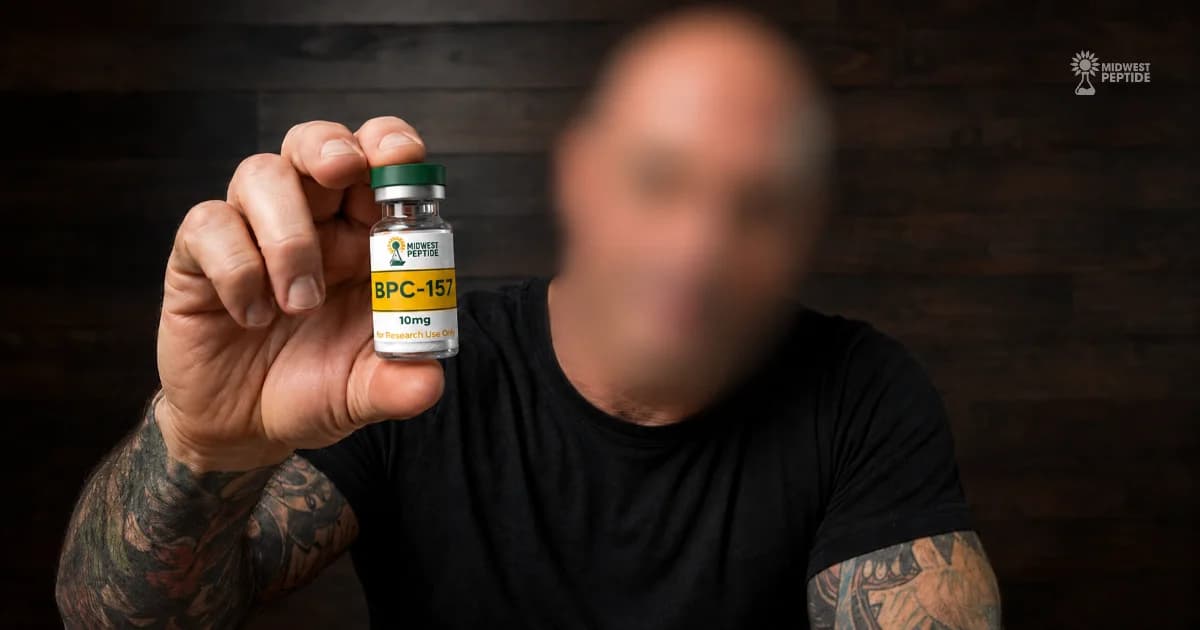
What Rogan has discussed. BPC-157 is the peptide most associated with Rogan. It has come up across multiple episodes, including conversations with neuroscientist Andrew Huberman and comedian Andrew Schulz. His on-air comments about it are casual and anecdotal, not scientific evidence.
What it is. BPC-157 (Body Protection Compound-157) is a synthetic 15-amino-acid research peptide derived from a partial sequence of a protein found in gastric juice.
What the research describes. The compound is most closely associated with the research group of Sikiric and Seiwerth and colleagues, who have published extensively on BPC-157 in animal models of tendon, ligament, muscle, and gastrointestinal injury. In these preclinical models, researchers have reported effects on fibroblast activity and collagen organization, along with interactions with angiogenic signaling pathways such as VEGFR2 and nitric oxide via the Akt-eNOS axis. A 2021 review in Frontiers in Pharmacology surveyed much of this animal literature (Seiwerth et al., Frontiers in Pharmacology, 2021). A separate 2025 narrative review of peptide research for ligaments and tendons summarized the evidence base and noted plainly that the near-total absence of human trials limits what can be concluded from it (narrative review, ScienceDirect, 2025). All of this is in vitro and animal work, and published human clinical data remain limited. BPC-157 is available for research purposes here.
TB-500 (discussed alongside BPC-157)
What Rogan has discussed. Rogan has talked about BPC-157 and TB-500 together, a combination that peptide communities colloquially nickname the "Wolverine stack." As with BPC-157, his on-air framing is casual rather than a clinical finding.
What it is. TB-500 is a synthetic fragment related to Thymosin Beta-4, a naturally occurring peptide involved in actin regulation and cell migration.
What the research describes. Thymosin Beta-4 is a small actin-sequestering peptide studied in laboratory models for its role in endothelial cell migration and angiogenesis. Researchers have identified a short actin-binding motif linked to that migratory and vessel-sprouting activity in cell-based assays (FASEB Journal, 2003). As with BPC-157, these are cell-culture and animal-model observations, and TB-500 is a synthetic research tool rather than a validated human therapeutic. TB-500 is available for research purposes here.
Ipamorelin and CJC-1295 (discussed)
What Rogan has discussed. Rogan has named Ipamorelin among the peptides he has talked about, usually within broader conversation about compounds that influence the body's own growth-hormone signaling.
What they are. Ipamorelin is a growth-hormone secretagogue that acts at the ghrelin/GHS receptor, and CJC-1295 is a growth-hormone-releasing hormone (GHRH) analog that acts at the GHRH receptor. In animal research they are used as tools to study the pulsatile release of growth hormone and the downstream IGF-1 axis, and Ipamorelin is noted in the literature for a comparatively selective secretagogue profile relative to earlier compounds in its class. The CJC-1295 and Ipamorelin blend is available for research purposes here.
Sermorelin and Tesamorelin (GHRH analogs, discussed)
What Rogan has discussed. Rogan has mentioned Sermorelin, another GHRH-class peptide, in the context of age-related changes in growth-hormone output.
What they are. Sermorelin and Tesamorelin are both GHRH analogs. Sermorelin corresponds to the GHRH(1-29) fragment and Tesamorelin is a stabilized GHRH analog; in research they serve as probes of the GHRH receptor and the growth-hormone axis. Tesamorelin is available for research purposes here.