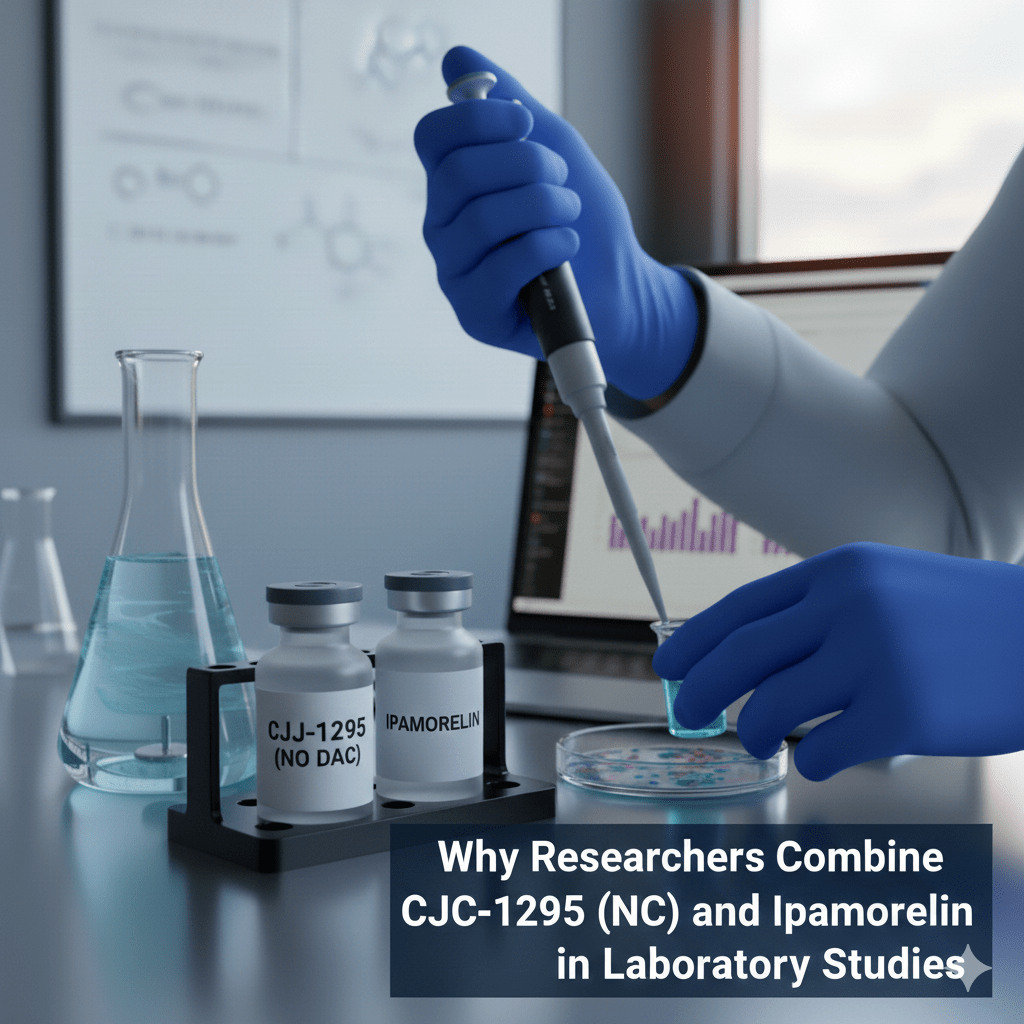
CJC-1295 (No DAC) and Ipamorelin are frequently combined in laboratory research to examine how distinct peptide mechanisms interact within growth hormone–related signaling pathways. By studying these compounds together, researchers can better understand timing, receptor activation, and pathway coordination under controlled experimental conditions.
The Scientific Rationale Behind Peptide Combination Studies
In peptide research, combining compounds allows investigators to observe interaction effects that may not be apparent when peptides are studied independently. CJC-1295 (No DAC) functions as a growth hormone–releasing hormone (GHRH) analog, while Ipamorelin selectively targets the growth hormone secretagogue receptor (GHS-R). Their differing mechanisms make them well-suited for concurrent pathway analysis.
How Each Peptide Functions Independently
- CJC-1295 (No DAC): Stimulates GHRH-related signaling with a short active duration.
- Ipamorelin: Activates GHS-R pathways with a selective receptor profile.
- Distinct Timing Profiles: Allows researchers to measure synchronized or staggered responses.
- Controlled Exposure: No DAC structure supports precise experimental timing.
Advantages of Using the No DAC Variant in Research
The No DAC version of CJC-1295 is commonly chosen for research requiring tight temporal control. Without the drug affinity complex, the peptide exhibits a shorter half-life, enabling repeated-measure studies and more granular observation of signaling onset and resolution.
Why Ipamorelin Complements CJC-1295 (No DAC)
Ipamorelin’s receptor selectivity makes it valuable in combination studies. Its focused interaction with GHS-R pathways allows researchers to evaluate cooperative signaling behavior without introducing excessive receptor cross-activity that could complicate data interpretation.
Common Research Objectives for This Peptide Blend
Researchers utilize the CJC-1295 (No DAC) and Ipamorelin combination to explore how parallel signaling routes influence growth hormone–related activity. These studies often focus on timing, amplitude, and consistency of pathway activation in vitro.
- Growth hormone signaling pathway coordination
- Peptide interaction and synergy modeling
- Receptor binding and response timing analysis
- Comparative single-peptide versus blend studies
Laboratory Handling and Preparation Considerations
Maintaining consistency in peptide preparation is critical for reproducible research outcomes. Both CJC-1295 (No DAC) and Ipamorelin are typically supplied in lyophilized form to support stability and accurate measurement during laboratory use.
- Storage: Keep peptides in a controlled, dry environment prior to reconstitution.
- Reconstitution Protocols: Follow sterile laboratory procedures.
- Environmental Control: Monitor temperature and exposure conditions.
- Documentation: Record preparation variables for experimental accuracy.
Who Benefits from Studying Peptide Combinations
- Research laboratories examining growth hormone signaling pathways
- Institutions conducting receptor interaction studies
- Scientific teams evaluating peptide synergy models
- Researchers requiring controlled, time-sensitive assays
Why Combination Research Improves Data Quality
Studying peptides in combination provides a more comprehensive view of biological signaling networks. By evaluating how CJC-1295 (No DAC) and Ipamorelin interact within the same experimental framework, researchers can identify response patterns that enhance understanding of pathway coordination and regulation.
Research-Only Use and Compliance Standards
This peptide blend is intended solely for in vitro laboratory research. It is not intended for human or veterinary use and is not designed for diagnostic, therapeutic, or clinical applications. All research should be conducted by qualified professionals in compliance with applicable laboratory guidelines.
“Understanding how peptides interact provides deeper insight than isolated studies alone. Controlled combination research supports clearer experimental conclusions.”
Advancing Peptide Research Through Thoughtful Design
Combining CJC-1295 (No DAC) and Ipamorelin allows researchers to design experiments that reflect real-world signaling complexity while maintaining laboratory control. With proper handling and documentation, this blend supports high-quality, repeatable research outcomes.
Developed for professional laboratory environments, this peptide combination offers a structured approach to studying growth hormone–related pathways through compliant, research-focused methodologies.