
Home » From ACTH to Heptapeptides: The Evolutionary Research History of Semax
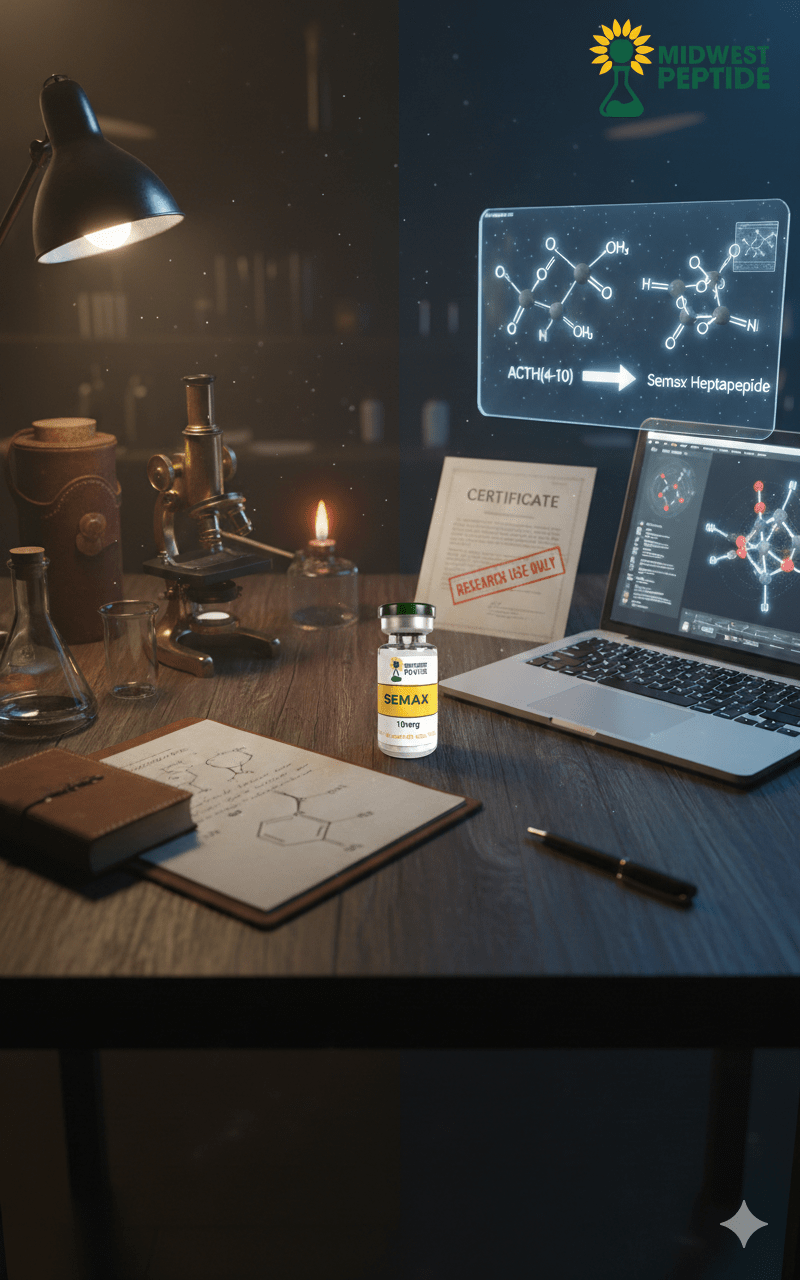
The development of Semax represents a significant milestone in the evolution of synthetic peptide design. Born from the intersection of classical endocrinology and modern molecular biology, Semax was developed as a more stable, non-hormonal alternative to naturally occurring fragments of the Adrenocorticotropic hormone (ACTH). For laboratories engaged in Semax research use only studies, understanding this evolutionary history provides vital context for its current application in neuro-synthesis and cellular signaling.
The research journey began in the late 1970s and early 1980s, when scientists investigated the “melanocortin” system. It was discovered that specific fragments of the ACTH molecule—specifically the 4-10 sequence—exhibited significant influence on the central nervous system without triggering the adrenal gland’s corticosteroid response. However, these natural fragments were extremely short-lived in a biological environment, often degrading within minutes due to enzymatic activity.
To overcome the limitations of the ACTH(4-10) fragment, researchers at the Institute of Molecular Genetics of the Russian Academy of Sciences engineered a synthetic analogue. By attaching a Pro-Gly-Pro tripeptide to the C-terminus of the ACTH fragment, they created the heptapeptide now known as Semax (Met-Glu-His-Phe-Pro-Gly-Pro).
The Pro-Gly-Pro tripeptide acts as a biological “shield.” This specific sequence is highly resistant to peptidases. In a research setting, this modification extended the peptide’s activity from mere minutes to several hours, allowing for more detailed longitudinal studies on gene expression and neurotrophic factor modulation.
Today, Semax research use only protocols require extreme technical precision. Synthesis must occur in a sterile environment using Solid Phase Peptide Synthesis (SPPS) to ensure the exact sequence is maintained. Independent expertise is required to verify that each batch provides the consistent molecular behavior necessary for high-impact scientific publications.
Because Semax is an ACTH analogue, it remains sensitive to temperature fluctuations once reconstituted. Laboratories must utilize specialized storage protocols—typically -20°C for lyophilized powder and 2-8°C for short-term experimental solutions—to preserve the peptide’s secondary structure and ensure research validity.
The transition from a raw hormone fragment to a precision-engineered heptapeptide illustrates the power of molecular modification. Researchers today use Semax to study complex systems like neuroplasticity, stroke recovery models, and cognitive stress responses, all built on the foundation of those early ACTH observations.
Despite its rich history and documented activity, Semax remains strictly for laboratory use. This designation ensures that the compound’s evolution continues to be driven by scientific data and peer-reviewed discovery rather than commercial claims. Maintaining RUO compliance is the best way for the research community to honor the evolutionary history of this unique peptide.
“Understanding where Semax came from allows us to better predict where it is going. The evolution from ACTH to a stable heptapeptide is a masterclass in synthetic chemical design.”
Delve deeper into the synthesis papers and historical data regarding ACTH analogues. Access high-purity Semax for your laboratory to continue the legacy of this fascinating heptapeptide—ensuring your research is grounded in history and compliant with modern RUO standards.
Providing the specialized knowledge and high-quality materials required for the next chapter of peptide research and molecular evolution.
Midwest Peptide supplies third-party tested research compounds with verified purity and identity. Based in the Midwest, we support academic and professional research nationwide with fast shipping, transparent lab reports, and consistent quality. Dependable materials.