Home » Comparative Analysis: Semax vs. Selank in Experimental Models
Comparative Analysis: Semax vs. Selank in Experimental Models
Table of Contents
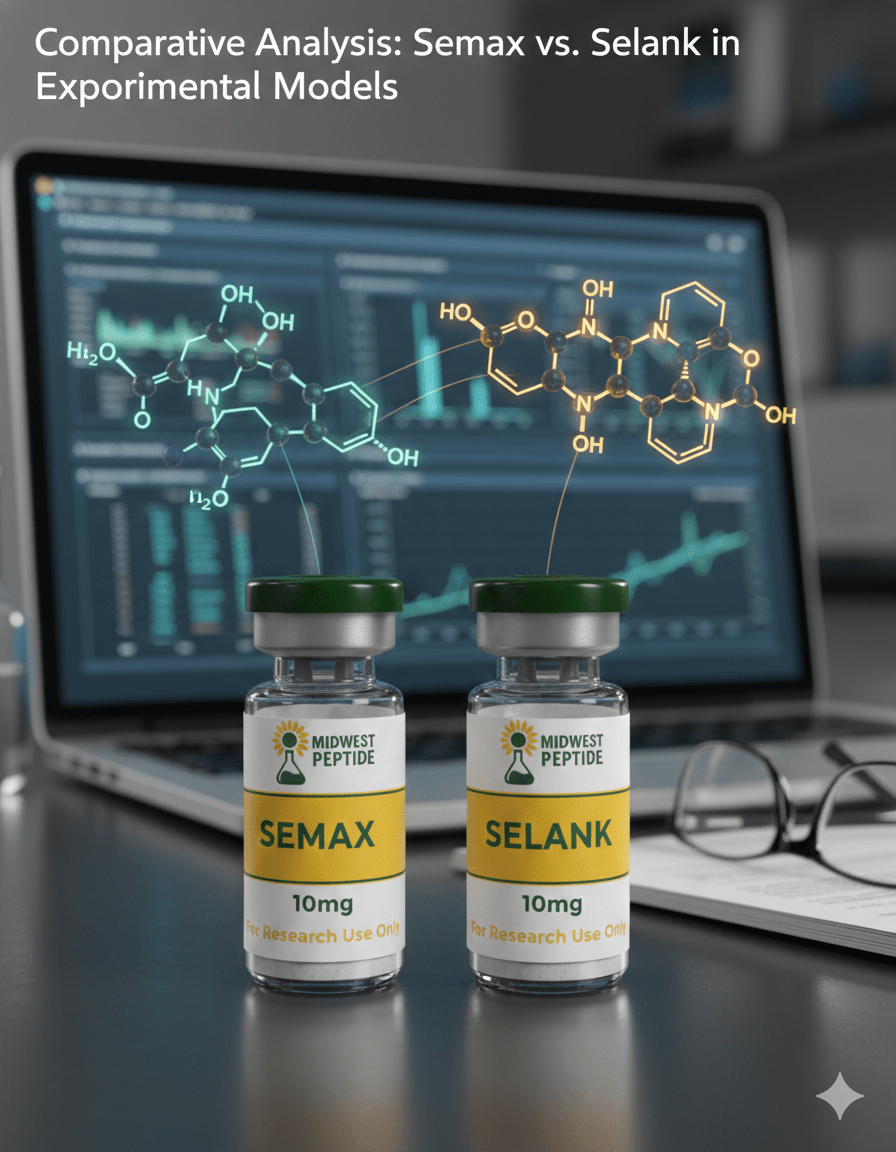
In the specialized field of peptide research, two synthetic analogues of endogenous regulatory peptides often stand at the forefront of neurological inquiry: Semax and Selank. While both were developed as stable, “Research Use Only” compounds based on natural sequences, their chemical structures and observed interactions in laboratory models are distinct. This comparative analysis explores the molecular divergence between these two peptides and their unique roles in experimental synthesis.
Chemical Foundations: Heptapeptide vs. Heptapeptide
Though they are both heptapeptides, Semax and Selank are derived from entirely different biological precursors. Semax is an analogue of the ACTH(4-10) fragment, while Selank is a synthetic analogue of the naturally occurring immunomodulatory peptide tuftsin (Thr-Lys-Pro-Arg).
Molecular Composition Comparison
Feature
Semax
Selank
Peptide Sequence
Met-Glu-His-Phe-Pro-Gly-Pro
Thr-Lys-Pro-Arg-Pro-Gly-Pro
Precursor
ACTH (Adrenocorticotropic Hormone)
Tuftsin (Immunomodulatory Peptide)
Stabilizing Tripeptide
Pro-Gly-Pro (C-Terminus)
Pro-Gly-Pro (C-Terminus)
Molecular Weight
810.9 g/mol
751.9 g/mol
Distinct Mechanisms in Experimental Models
Semax: Focus on Neurotrophic Synthesis
In in vitro studies, Semax is primarily researched for its ability to modulate Brain-Derived Neurotrophic Factor (BDNF) and Nerve Growth Factor (NGF). Its laboratory application often revolves around neuro-regeneration models, stroke pathology simulations, and the study of gene expression related to the vascular system. Researchers utilize Semax when the goal is to observe rapid shifts in mRNA levels within neuronal tissues.
Selank: Focus on Neuro-Anxiolytic and Immune Pathways
Conversely, Selank research frequently focuses on the modulation of the GABAergic system and its interaction with the immune response. Because it is derived from tuftsin, Selank is a primary subject in studies investigating the chemical basis of stress-reduction and immune-neuronal signaling. In experimental models, Selank has been observed to influence the metabolism of serotonin and norepinephrine, making it a unique variable for research into emotional regulation chemistry.
Shared Stability: The Role of Pro-Gly-Pro
One of the few similarities between these two peptides is the addition of the Pro-Gly-Pro sequence. This modification is what allows both compounds to be utilized effectively in research settings. Without this “cap,” both the ACTH fragment and the tuftsin analogue would degrade too quickly for meaningful observation. This shared structural feature ensures that both peptides exhibit the proteolytic stability required for high-quality, reproducible laboratory data.
Evaluating the Variables: When to Use Which Peptide
For Neuroplasticity Studies: Semax research use only protocols are often preferred due to the documented upregulation of neurotrophins.
For Stress-Response Models: Selank is typically the compound of choice when investigating anxiolytic pathways or GABA receptor interactions.
For Immunological Research: Selank’s relationship to tuftsin makes it the more relevant subject for studying the “brain-immune” axis.
For Vascular Research: Semax’s influence on VEGF (Vascular Endothelial Growth Factor) expression makes it the primary candidate for blood-flow-related experimental modeling.
The Importance of High-Purity Compounds
Whether a lab is investigating Semax or Selank, the purity of the synthetic peptide is the most critical factor in the success of the study. Independent expertise in peptide synthesis ensures that there is no cross-contamination between batches. For accurate comparative analysis, both peptides must be sourced with a purity level exceeding 98%, verified by HPLC and Mass Spectrometry.
Research Consistency: High purity eliminates “noise” in cellular assays.
Batch Reliability: Enables researchers to compare different trials over long-term projects.
Compliance: Ensures the material adheres to strictly RUO standards.
Regulatory and Safety Overlap
It is vital to reiterate that both Semax and Selank are strictly for Research Use Only. They are not to be used as therapeutic agents or clinical medications. By maintaining this boundary, laboratories can continue to explore the fascinating differences between these two ACTH and tuftsin analogues without compromising the ethical standards of the scientific community.
“While Semax and Selank share a stabilizing tail, their molecular ‘heads’ lead them down very different biological paths. Choosing the right peptide depends entirely on the specific signaling pathway being modeled.”
Access Comparative Research Materials
Equip your laboratory with the technical data needed to conduct side-by-side studies of Semax and Selank. Review certificates of analysis, compare solubility profiles, and source high-purity peptides to advance your understanding of neuro-synthesis and immunomodulation in a compliant research environment.
Supporting independent researchers with the high-quality peptides and technical insights necessary for cutting-edge neurochemical exploration.
Midwest Peptide supplies third-party tested research compounds with verified purity and identity. Based in the Midwest, we support academic and professional research nationwide with fast shipping, transparent lab reports, and consistent quality. Dependable materials.