Home » How to Reconstitute Selank: A Guide to Laboratory Preparation
How to Reconstitute Selank: A Guide to Laboratory Preparation
Table of Contents
In the field of peptide synthesis and neurological modeling, the validity of your data depends entirely on the integrity of your starting material. Selank (Thr-Lys-Pro-Arg-Pro-Gly-Pro) is a highly stable heptapeptide, but like all synthetic sequences, it is sensitive to the environment in which it is prepared.
For laboratories focused on Selank research use only applications, mastering the reconstitution process is the first step toward ensuring reproducible and accurate experimental results.
Understanding the Lyophilized State
Selank is typically supplied as a lyophilized (freeze-dried) powder. This state is ideal for long-term storage because it removes the water necessary for most degradation reactions. However, once you introduce a solvent, the “biological clock” of the peptide begins to tick.
Step 1: Selecting the Correct Solvent
The choice of diluent can affect the pH and the solubility of the peptide. For most in vitro and in vivo research models, the following are the industry standards:
Bacteriostatic Water: Most common for research due to the inclusion of 0.9% benzyl alcohol, which prevents bacterial growth.
Sterile Saline (0.9% NaCl): Often used when maintaining an isotonic environment is critical for cellular assays.
Acetic Acid (0.1%–1%): In rare cases where the peptide does not dissolve in water, a weak acid can assist in breaking the intermolecular bonds.
Step 2: Calculating Concentration
Accuracy in dosing starts with the math. Most Selank vials contain 5mg or 10mg of material. To achieve a specific concentration, use the formula:
$$C = \frac{m}{V}$$
Common Dilution Ratios for a 10mg Vial:
Target Concentration
Solvent Volume (mL)
2mg/mL
5.0 mL
5mg/mL
2.0 mL
10mg/mL
1.0 mL
Step 3: The Reconstitution Process (Best Practices)
Peptides are fragile. The physical act of mixing can damage the molecular structure if done too aggressively.
Temperature Equilibrium: Allow the vial to reach room temperature before opening to prevent condensation.
Sterilization: Wipe the rubber stopper of the vial with an alcohol swab (70% isopropyl).
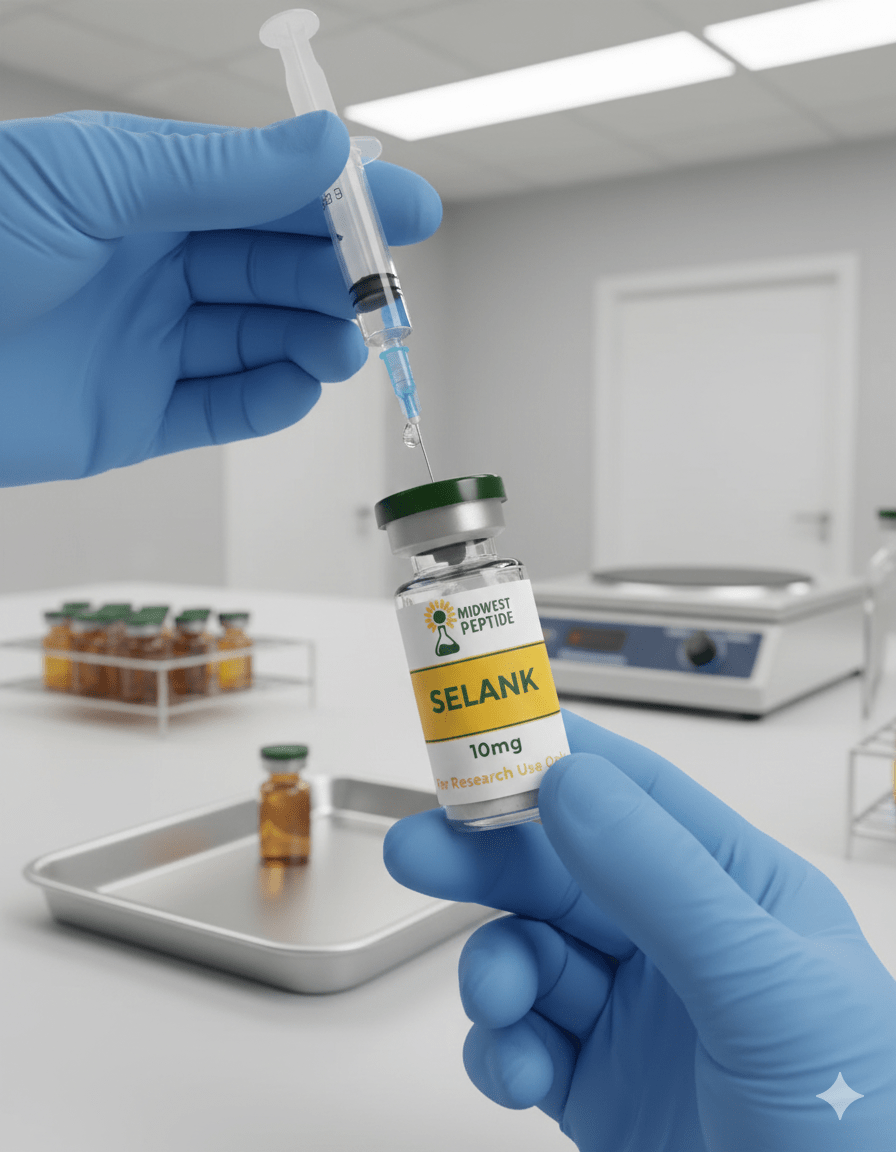
Gentle Introduction: Use a syringe to drip the solvent down the inside wall of the vial rather than spraying it directly onto the powder.
The Swirl Method: Do not shake the vial. Gently swirl the liquid in a circular motion until the powder is completely dissolved.
Step 4: Storage and Stability Post-Reconstitution
Once Selank is in liquid form, its shelf life decreases. To maintain its Research Use Only integrity:
Short-term Storage: Keep the vial at $2\text{–}8^{\circ}\text{C}$. Stability is typically maintained for 14–21 days.
Long-term Storage: Aliquot the solution into smaller, single-use tubes and freeze at $-20^{\circ}\text{C}$ or $-80^{\circ}\text{C}$ to avoid freeze-thaw cycles.
Avoiding Common Pitfalls
Contamination: Always work under a laminar flow hood for sensitive cell cultures.
Light Sensitivity: Keep the reconstituted peptide in the dark to avoid UV-catalyzed breakdown.
Incorrect pH: Avoid highly alkaline solvents which can cause deamidation of the peptide chain.
“Precision in the reconstitution phase is as critical as the synthesis itself. A single error in handling can compromise weeks of laboratory observation.”
Sourcing High-Purity Materials
No amount of careful preparation can fix an impure product. To ensure your research meets peer-review standards, always verify your Selank with a Certificate of Analysis (CoA) showing a purity of 98% or higher.
Midwest Peptide supplies third-party tested research compounds with verified purity and identity. Based in the Midwest, we support academic and professional research nationwide with fast shipping, transparent lab reports, and consistent quality. Dependable materials.