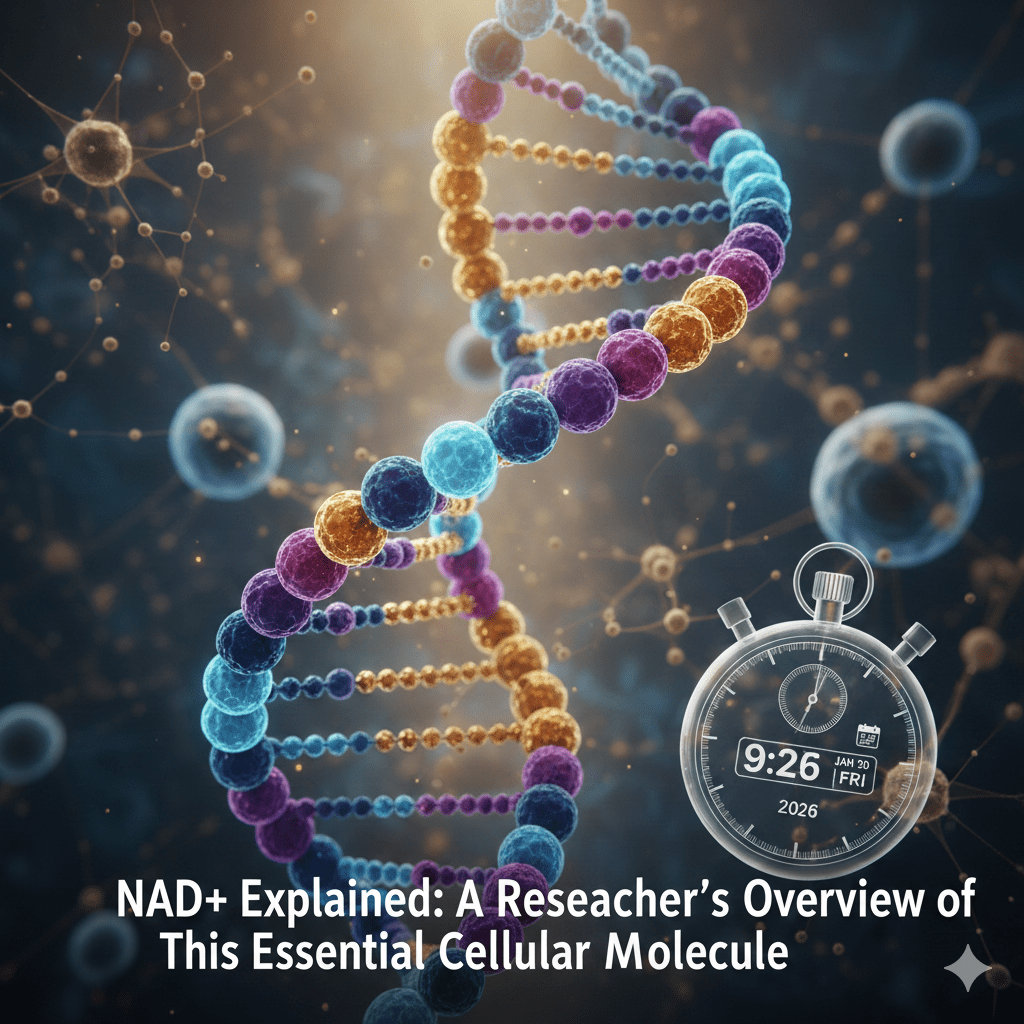
Nicotinamide adenine dinucleotide (NAD+) is a fundamental molecule studied extensively in biochemical and cellular research. Present in all living cells, NAD+ plays a critical role in energy metabolism, redox reactions, and cellular signaling. Its central position in multiple biological pathways has made it a key focus in modern laboratory research.
What Is NAD+?
NAD+ is a coenzyme involved in oxidation-reduction (redox) reactions that are essential for cellular energy production. In its oxidized (NAD+) and reduced (NADH) forms, it functions as an electron carrier, enabling metabolic reactions that support cellular function. Researchers study NAD+ to better understand how cells regulate energy balance and metabolic efficiency.
Key Characteristics of NAD+
- Universal Presence: Found in all living cells across species.
- Redox Function: Transfers electrons during metabolic reactions.
- Energy Metabolism: Supports pathways involved in ATP production.
- Research Versatility: Used in a wide range of in vitro biochemical studies.
The Role of NAD+ in Cellular Energy Pathways
NAD+ is a key participant in metabolic pathways such as glycolysis, the citric acid cycle, and oxidative phosphorylation. By accepting and donating electrons, NAD+ enables enzymatic reactions that drive energy production. Laboratory research often focuses on how changes in NAD+ availability influence cellular efficiency and metabolic output.
Why NAD+ Matters in Metabolic Research
- Supports enzymatic activity in energy-producing pathways
- Acts as a regulator of cellular redox balance
- Plays a role in mitochondrial function studies
- Provides insight into metabolic adaptation and stress responses
NAD+ and Cellular Signaling Research
Beyond its role in metabolism, NAD+ serves as a substrate for enzymes involved in cellular signaling processes. These pathways influence gene expression, DNA repair mechanisms, and cellular stress responses. Researchers investigate NAD+ to understand how signaling pathways are regulated and how cellular systems maintain homeostasis.
Common Research Applications
- Cellular energy and metabolism modeling
- Redox reaction and enzyme activity studies
- DNA repair and cellular maintenance research
- In vitro signaling pathway analysis
Laboratory Handling and Stability Considerations
For accurate and reproducible results, proper handling of NAD+ is essential. NAD+ is commonly supplied in stabilized forms suitable for laboratory use. Researchers must follow appropriate storage and preparation protocols to preserve molecular integrity during experimentation.
- Storage Conditions: Store in a cool, dry environment away from light.
- Sterile Preparation: Use laboratory-grade sterile techniques during preparation.
- Controlled Use: Minimize exposure to degrading conditions during experiments.
- Documentation: Record preparation and experimental variables consistently.
Who Studies NAD+ in Research Settings
- Biochemistry and molecular biology laboratories
- Researchers studying cellular metabolism and energy balance
- Scientific teams focused on mitochondrial function
- Institutions conducting in vitro cellular pathway analysis
Why NAD+ Remains a Research Focus
NAD+ continues to be a focal point in laboratory research due to its involvement in multiple essential cellular processes. Its influence on metabolism, signaling, and cellular maintenance makes it a valuable molecule for understanding fundamental biological mechanisms.
Research-Only Compliance Standards
NAD+ supplied for laboratory use is intended strictly for research and in vitro experimentation. It is not approved for human or veterinary use and is not intended for clinical, therapeutic, or diagnostic applications. All research should follow institutional safety protocols and regulatory guidelines.
“NAD+ sits at the intersection of energy metabolism and cellular regulation, making it one of the most important molecules studied in modern biochemical research.”
Advancing Cellular Research with NAD+
By studying NAD+, researchers gain insight into the fundamental processes that sustain cellular function. With proper handling and experimental design, NAD+ supports reliable, reproducible research across a wide range of biochemical and metabolic studies.
For laboratories focused on understanding cellular energy, signaling, and metabolism, NAD+ remains an essential research molecule for controlled in vitro investigation.