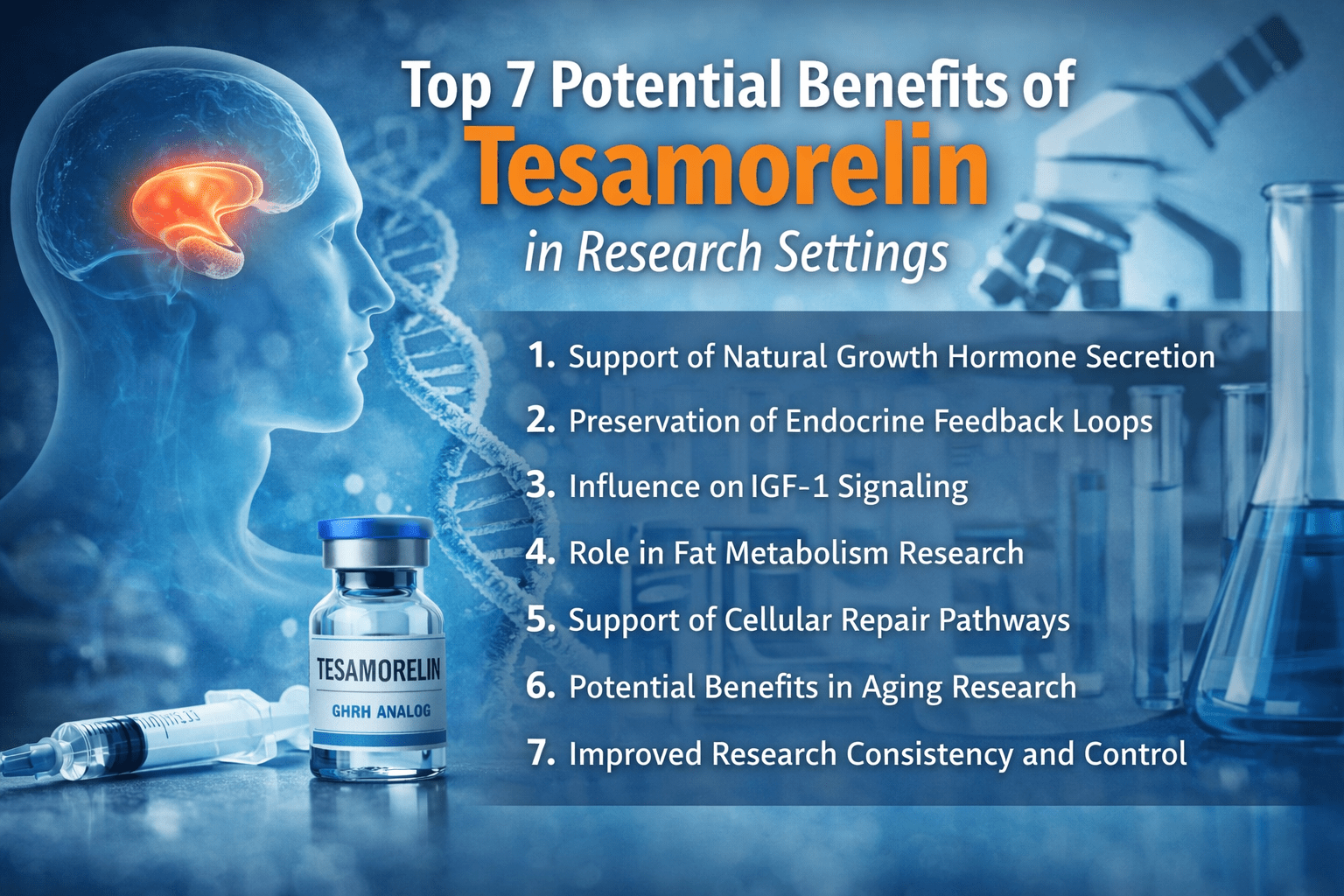
Tesamorelin continues to attract attention in scientific research due to its ability to stimulate natural growth hormone release through targeted endocrine signaling. As researchers seek compounds that support physiological balance rather than hormone replacement, Tesamorelin stands out for its upstream mechanism and controlled activity.
By acting as a growth hormone–releasing hormone (GHRH) analog, Tesamorelin allows investigators to explore how enhanced growth hormone signaling may influence metabolism, cellular repair, and long-term hormonal regulation. Below are seven key areas where Tesamorelin is commonly studied and why it remains a valuable research compound.
Why Tesamorelin Is Widely Studied
Growth hormone affects numerous biological systems, including fat metabolism, protein synthesis, and tissue maintenance. Tesamorelin’s ability to stimulate endogenous hormone release—rather than introducing external hormones—makes it especially useful in research environments focused on sustainable and regulated outcomes.
1. Support of Natural Growth Hormone Secretion
One of the most studied benefits of Tesamorelin is its role in promoting pulsatile growth hormone release. This mimics the body’s natural secretion patterns, allowing researchers to observe hormonal effects without suppressing the pituitary’s normal function.
2. Preservation of Endocrine Feedback Loops
Because Tesamorelin works upstream in the hormonal cascade, it preserves natural feedback mechanisms. This allows scientists to study growth hormone dynamics while maintaining regulatory balance, which is critical for long-term endocrine research.
3. Influence on IGF-1 Signaling
Growth hormone stimulates the production of insulin-like growth factor 1 (IGF-1), a key mediator of cellular growth and repair. Tesamorelin-driven growth hormone release enables researchers to examine how moderate, controlled increases in IGF-1 impact tissue regeneration and metabolic efficiency.
4. Role in Fat Metabolism Research
Tesamorelin is frequently included in studies examining lipid metabolism and fat distribution. Growth hormone is known to influence lipolysis, particularly in visceral fat stores, making Tesamorelin relevant in research focused on body composition and metabolic adaptation.
5. Support of Cellular Repair Pathways
Growth hormone plays a role in collagen synthesis, tissue repair, and cellular turnover. Researchers investigating recovery, regeneration, and resilience often study Tesamorelin to better understand how enhanced hormone signaling may support these processes.
6. Potential Benefits in Aging Research
As growth hormone levels naturally decline with age, Tesamorelin is frequently studied in aging models. Researchers explore how restoring more youthful hormone signaling patterns may influence metabolic health, tissue maintenance, and overall physiological function.
7. Improved Research Consistency and Control
Tesamorelin’s targeted mechanism allows for predictable and measurable outcomes in controlled environments. This makes it valuable for comparative studies, dose-response research, and long-term investigations into hormonal signaling efficiency.
Who May Benefit From Tesamorelin-Based Research
- Researchers studying growth hormone regulation and balance
- Scientists focused on metabolic efficiency and fat distribution
- Investigators exploring cellular repair and regeneration
- Laboratories conducting aging and longevity research
Why Tesamorelin Remains a Key Research Peptide
Tesamorelin’s ability to stimulate natural growth hormone release while maintaining endocrine regulation has positioned it as a cornerstone compound in peptide research. Its versatility across metabolic, regenerative, and hormonal studies continues to drive scientific interest.
As research into peptide-based signaling expands, Tesamorelin remains a reliable and informative tool for understanding how growth hormone pathways influence overall physiological performance.