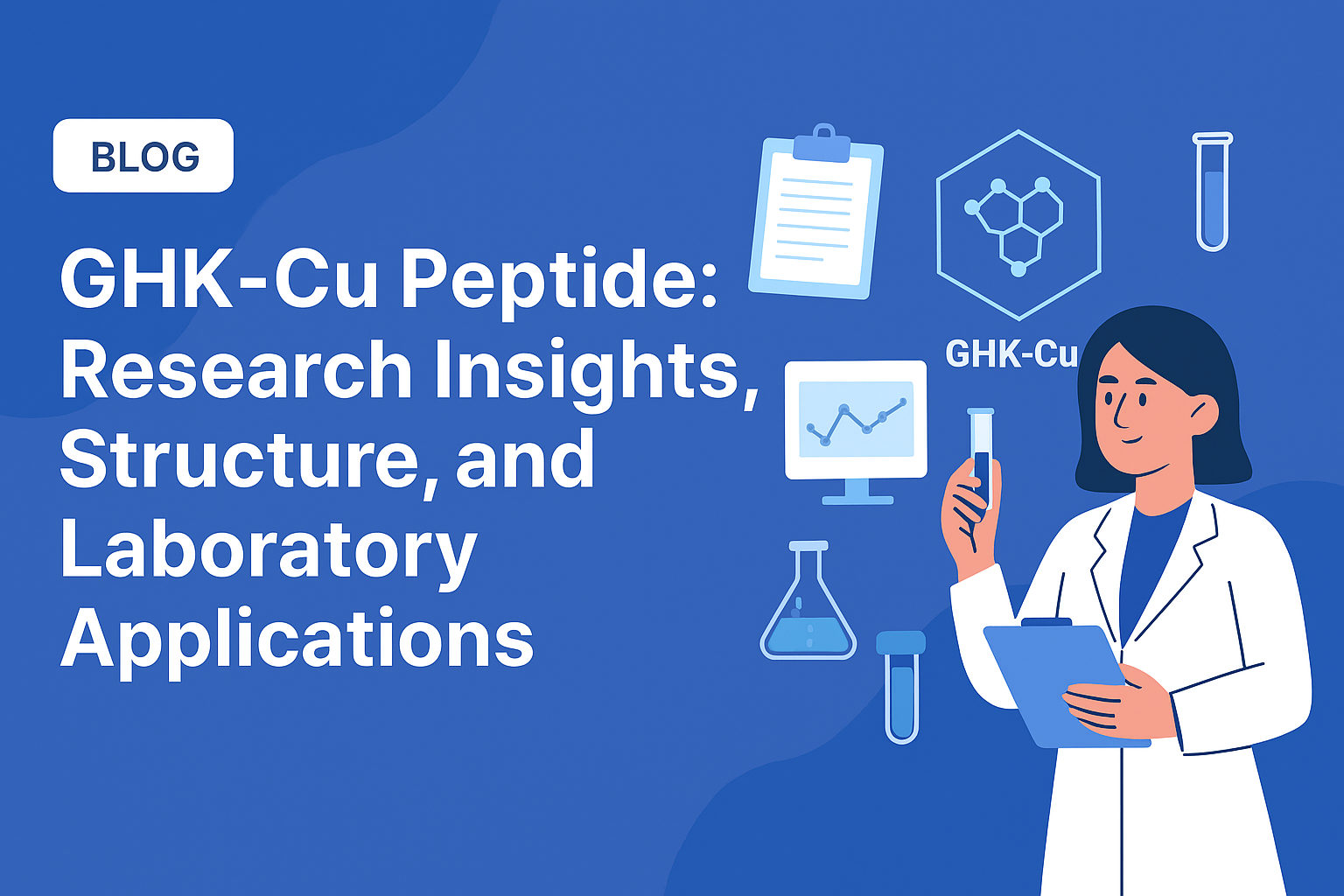
GHK-Cu, or Glycyl-L-Histidyl-L-Lysine-Copper, is a naturally occurring copper-binding peptide that has gained significant attention in research laboratories worldwide. Known for its biochemical complexity and high binding affinity for copper ions, GHK-Cu is studied extensively for its role in various biological and molecular processes. This article explores what GHK-Cu is, how it functions, and why it continues to be a valuable tool for scientific and educational research—strictly for research use only.
What Is GHK-Cu?
GHK-Cu is a small tripeptide composed of glycine, histidine, and lysine that naturally binds with copper ions to form a stable complex. Researchers study GHK-Cu for its potential to interact with different cellular and biochemical systems, offering insight into copper metabolism, peptide signaling, and cellular repair mechanisms. Because of its unique composition, it serves as a useful model compound for exploring peptide-metal interactions.
Chemical Structure and Stability
The GHK-Cu complex forms through the chelation of copper(II) with the GHK peptide sequence. Its molecular weight is approximately 403.9 g/mol, and the blue coloration of the complex is characteristic of copper coordination. In laboratory conditions, maintaining stability requires appropriate storage—typically at controlled temperatures and pH levels to preserve peptide integrity.
How GHK-Cu Is Used in Research
In modern research, GHK-Cu serves as a valuable compound for understanding copper’s biological roles and the interactions between trace metals and peptides. Scientists use it across biochemical, molecular, and cell-based studies to explore cellular signaling pathways and gene expression regulation. While it is not intended for human or animal use, GHK-Cu’s structure allows researchers to simulate biological conditions and study molecular dynamics safely within controlled environments.
Applications in Scientific Settings
- Biochemical Research: Investigating peptide-metal interactions and copper transport mechanisms.
- Cell Culture Studies: Evaluating cellular responses to trace elements in a controlled environment.
- Material Science: Exploring copper-peptide binding as a model for biomimetic design and metal coordination chemistry.
- Genetic Expression Studies: Studying peptide influence on gene modulation in non-clinical research models.
Analytical Methods for Studying GHK-Cu
Researchers commonly analyze GHK-Cu using advanced laboratory techniques such as mass spectrometry, high-performance liquid chromatography (HPLC), and spectrophotometric assays. These tools help quantify purity, confirm molecular identity, and assess binding characteristics. Data from these methods provide foundational insights into how copper complexes behave under different experimental conditions.
Storage and Handling Considerations
Proper handling is essential to maintain the integrity of GHK-Cu samples. The peptide should be stored in a cool, dry environment, protected from light and moisture. For long-term preservation, freezing in aliquoted form can prevent degradation. All handling should follow standard laboratory safety procedures and local compliance regulations.
Current Trends in GHK-Cu Research
As interest in peptide science expands, GHK-Cu remains a point of focus for its distinct metal-binding profile. Research continues to explore its potential in diverse experimental fields, including biochemistry, pharmacology, and molecular biology. Ongoing studies aim to clarify its effects on gene expression, cell signaling, and copper homeostasis—all within strictly regulated laboratory contexts.
How GHK-Cu Supports Educational and Laboratory Learning
Beyond research, GHK-Cu also provides an excellent teaching tool for chemistry and biochemistry students. Its simple structure combined with unique metal-binding behavior makes it ideal for demonstrating real-world applications of peptide chemistry, coordination bonds, and bioinorganic principles.
- Educational Value: Demonstrates peptide synthesis, metal coordination, and stability testing.
- Laboratory Relevance: A model for studying trace element interactions in controlled environments.
- Research Versatility: Suitable for a range of biochemical and analytical methods.
Compliance and Research-Only Disclaimer
GHK-Cu is provided strictly for laboratory research purposes. It is not approved for human or animal use, consumption, or therapeutic application. All research involving GHK-Cu should be conducted by qualified professionals in compliance with institutional and regulatory guidelines.
“Advancing peptide science begins with curiosity and compliance. GHK-Cu continues to inspire researchers to explore the chemistry of copper and its connection to biological systems—responsibly and ethically.”
Explore GHK-Cu Research Materials
Researchers seeking to study GHK-Cu can explore high-purity laboratory-grade materials from verified suppliers. Always ensure certificates of analysis (COAs) and lot documentation are available to confirm quality and traceability.